What this HD download actually contained
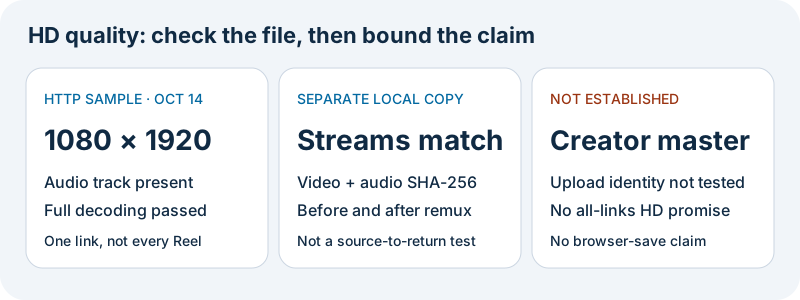
We submitted one public Reel link to Vidlune's existing download endpoint on October 14, 2026. The completed response was HTTP 200 with the video/mp4 content type. Its received byte count matched the declared response length. FFmpeg identified a VP9 video stream at 1080×1920 and an HE-AAC audio stream at 44,100 Hz, stereo; the reported duration was 35.97 seconds.
We then decoded the entire returned video and audio, not just a thumbnail or the first frame. The decoder exited successfully. An audio stream being present and decodable does not establish how it sounds on your phone. The measured 6.287 seconds covers the request through receipt of the complete body; it excludes the later decoding check and is not a speed average.
The public check record includes the sample link, timestamp, exact byte count and SHA-256 fingerprint so you can identify the file tested. We are not republishing the clip here.
HD is a quality question, not another download button
For this page, the useful answer is the returned file's dimensions and verification result. The word “HD” on a button does not measure either. Our observed 1080×1920 frame is portrait Full HD. It says nothing about untested links, and it is not evidence of 4K availability.
A public discussion asks, “did anyone have a solution to download full quality instagram reel ?” Our answer is the dated file evidence above, with its limits—not a claim that an “original quality” label proves no processing anywhere.
Does Vidlune re-encode the HD Reel?
The MP4 path inspected for this check requests --remux-video mp4; it does not request --recode-video. The inspected format preference tries MP4 video and M4A audio before fallback formats. It does not contain a fixed 1080p height selector. This is a statement about the inspected implementation, not a guarantee of the resolution returned by every source link.
The yt-dlp post-processing documentation distinguishes remuxing into a container from re-encoding. FFmpeg's stream-copy documentation explains that stream copying bypasses decoding, filtering and encoding. Neither fact proves that Instagram did no processing before making a rendition available.
A separate stream-copy check on the received file
On October 14 we locally remuxed that already-received MP4 using FFmpeg's -c copy, mapping its video and audio streams into another MP4. We compared SHA-256 values for the encoded video and audio streams before and after this operation. Both stream hashes matched, and the remuxed output also passed full decoding.
This experiment demonstrates a no-reencoding remux of our received sample. It is not a second Instagram download, a capture of the running download backend's intermediate streams, or a comparison against the creator's original upload. The record keeps these results separate from the HTTP measurement. A container can change without the encoded video or audio changing; a whole-file hash alone would not explain that distinction.
Download Instagram Reels HD using the existing tool
Use the existing Instagram Reel downloader for a permitted public link. This guide does not add another download entry point or a manual quality selector. “IG reel downloader HD,” “download Insta Reels HD” and “Instagram Reels HD download” describe the same quality question here, not separate tools.
If your saved result is only 720p, the 720p troubleshooting guide handles that lower-resolution result. If a nonempty MP4 does not play, use the codec guide. This page answers what HD quality we actually received and what the evidence proves; it does not promise to upscale a lower-resolution source.